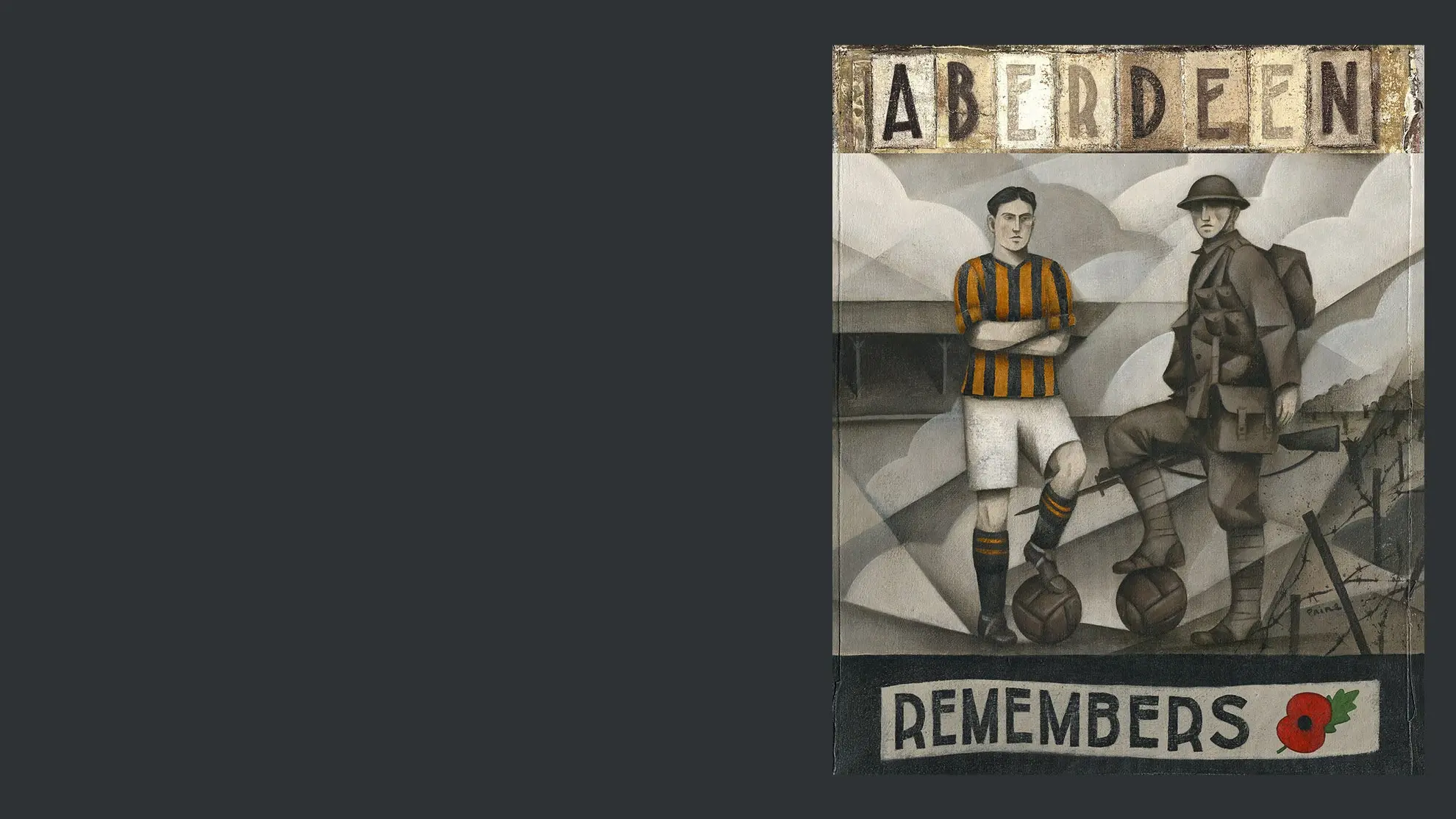
The Great War of 1914-1918 claimed the lives of almost 10 million soldiers from around the world and left much suffering from the physical and mental scars that the conflict caused.
In Aberdeen and at Pittodrie, the normal preparations were made in time for the new 1914/15 season but by the beginning of August, Germany had mobilised armed forces and had declared war on Russia. Two weeks later, Aberdeen opened their season with a 3-1 win against Dundee at Dens Park after Britain had declared war on Germany. Manager Phillip brought in several new faces to the side with Bert MacLachlan joining from Aston Villa. Bobby Archibald was signed from Third Lanark and keeper George Anderson arrived after a spell with Newcastle. Football’s decision to continue playing after the outbreak of war was a source of controversy and for many a moral issue. The debate said a lot about football’s place in society back then; in England the League started in September by which time Aberdeen had played their first three matches. As British troops were retreating at Mons, football continued despite claims from politicians for players with “strength of limb” to serve and march to the battlefield.
There was also the amateur and professional debate as players being paid was effectively “bribing much needed recruits” from the war effort. In Scotland, the War Office and the Scottish League agreed that league football would continue ‘for as long as possible’ with the Scottish Cup suspended. At Pittodrie, the effects of the war were soon to become clear. Within weeks, defenders Bobby Hannah and Alex Wright were called up to the Forces. There was also a dramatic fall in attendances which had a huge impact on the club’s finances. With more young men being sent to join the war effort, the claims “that it would be all over by Christmas” were quickly dismissed.
The playing staff at Pittodrie was decimated but they still managed to complete the season without too much difficulty.
By 1915 the club continued to struggle on and when a lowly 1,500 turned up for the game against Ayr United in September 1915, it became clear how difficult the situation had become. The club had also saw no less than 14 registered players either enlist or be conscripted to the war effort. However the club continued and once again finished their season in a credible 11th place.
However the folly of continuing playing was all too clear in the coming months.
Travelling to fulfil fixtures was becoming difficult. With little or no money coming through the gate, the club were effectively surviving day to day. In 1916, the club did consider pulling out of the league. The problem that the Aberdeen officials faced was the prospect of being isolated from league football when the war was finally over and football would return to normal.
It was well known inside the game that a club from the west of Scotland was ready to step in and take Aberdeen’s place. The club had no intention of quitting and their resolve would be unbroken. 1916/17 ended with Aberdeen bottom of the table. To highlight some of the problems faced, when Aberdeen travelled to face Kilmarnock on 27th January 1917, they missed their train connection to Ayrshire, arriving at Rugby Park some 25 minutes late.
Having changed on the train, they went on to play and were beaten 7-0, a then club record defeat. A week later, Aberdeen beat league leaders Rangers 3-1 at Pittodrie. With only seven wins all season, Aberdeen finished two points behind Raith at the foot of the table. The sad state of affairs was compounded in their final league game of the season at Cappielow as Aberdeen could only raise ten players. Their hosts ‘loaned’ them one of their reserve players so Aberdeen could take the field with a full team. Meanwhile in the Great War, Britain introduced conscription as pressure on resources intensified.
The Battle of Verdun began and that gruesome conflict would last for ten months with more than a million casualties. In 1916, the Women’s Army Auxiliary was founded. The war came closer to home when a zeppelin raided Edinburgh with 13 deaths and 24 wounded. The Allied Forces were forced to surrender to Turkish forces at Kut after 143 days with around 9,000 British and Indian troops captured. A turning point finally came in May 1916 when the German fleet was irreparably damaged in the Battle of Jutland.
At Pittodrie, the situation had become desperate.
There was no prospect of the club being in a position to compete in football by the start of 1917. Aberdeen, along with Dundee and Raith Rovers, had no option but to withdraw from the league until the end of hostilities. But at least the decision held out hope for the future. Had the club ceased playing two years previously, they would have been left out in the cold. Now they knew that they would be welcomed back when the time came. The hope was that the financial situation would have improved. Between 1917 and 1919 there was no competitive football played in the north east of Scotland.
Those left at the club would dedicate their time to the war effort and minor football. Pittodrie closed its doors and braced itself for the end of the Great War. Meanwhile in Europe, the Western Front was the focus of the conflict and the battle of Verdun finally came to an end. It was the longest and most costly conflict. In early 1917, the United States severed diplomatic ties with Germany as U-Boats threatened US shipping. Two months later the US declared war on Germany and troops began to mobilise immediately. 1917 brought significant advances for the Allies while the first American troops landed in France in June.
Later that year the Ypres Offensive began, which was seen as a significant gain for the Allied Forces. By the end of the year Britain had liberated Jerusalem ending 673 years of Turkish rule. By March 1918 the German assaults had reached the Somme. The greatest air battle of the war took place with over 70 aircraft involved. A month later, the German advances were halted by the British and Australian forces at Amiens. In September 1918 the Great British Offensive on the Cambrai Front led to the storming of the Hindenburg Line.
By October 1918 Germany asked the Allies for an armistice, while the whole Channel coast west of Flanders was liberated from German occupation. As the Turkish forces surrendered to the British, Germany signed the armistice at 6am on November 11th 1918 – to bring an end to the conflict.
The Great War affected all parts of the country like never before.
It is inconceivable these days to think football and any kind of normal daily life could continue while such horror was continuing on the battlefields. The Gordon Highlanders Museum in Aberdeen is home to some rare artefacts and evidence of the harrowing tales from the conflict. Some of the items are particularly poignant; a Benson & Hedges tobacco tin has a folded piece of Gordon Highlanders tartan, still marked in dried mud of the battlefield 100 plus years on.
Beside that is a tiny version of the New Testament. An accompanying letter to a soldier’s mother tells all that her son died in action in November 1917. “He was killed instantaneously by a shell and suffered no pain whatsoever. He was a quiet lad and much respected by his soldier comrades. His Testament has been handed over to the authorities and will no doubt reach you in due course. I cut a bit of tartan from his kilt and enclose some as it is something you might appreciate.” Such tales were replicated a thousand times over and those at home never really understood the scale of the atrocities and the reality of the conflict until many years later.
At Pittodrie it was very much a case of picking up the pieces.
Two years of closure and the ongoing conflict had left the club very much in turmoil.
In an effort to reclaim some togetherness, a sequence of friendly matches were arranged before and after the club reconvened in May 1919. It was reported that most of the players who had served the club before the war had re-signed for Aberdeen.
ABERDEEN FOOTBALL CLUB HERITAGE TRUST WAR MEMORIAL ROLL OF HONOUR
At the Annual General Meeting of Aberdeen Football Club on 1st August 1919, Mr Tom Duncan, Chairman, paid tribute to the thirty-three Players and Officials who gave service in the Great War, eight of whom made the supreme sacrifice. Other men who had been associated with the club also died in that conflict, as did three others in the Second World War.
They are all remembered on the Aberdeen FC Heritage Trust Roll of Honour in the Richard Donald Stand.
They include one-time Captain, Alex Halkett and reserve players Andrew Hamilton and Allan Lawrie. In the 1940’s two promising young players also died: John Waran Campbell and George Scott, both of whom were serving in the Royal Air Force. Each individual deserves equal respect but it is notable that the list includes two brothers – Charles and James Neilson from Ellon, who also had another brother killed in the conflict.
Aberdeen War Memorial | Two important ceremonies were carried out in Aberdeen , the first being the dedication of the city’s handsome War Memorial by Moderators Right Rev. Dr John White and Right Rev. Dr. James Harvey. A general view of the ceremony. 7th September 1925.
ABERDEEN FOOTBALL CLUB HERITAGE TRUST
WAR MEMORIAL ROLL OF HONOUR
WORLD WAR I
Private Allan Lawrie 1915 (Queen’s Own Cameron Highlanders)
Private Andrew Hamilton 1915 (Gordon Highlanders)
Sergeant-Major John Mackay 1916 (Royal Engineers)
Company Sergeant-Major Charles Neilson 1916 (Gordon Highlanders)
Gunner Alex L Halkett 1917 (Royal Field Artillery)
Captain Joseph Ellis Milne DSO 1917 (Royal Medical Corps)
Gunner John Munro 1917 (Royal Field Artillery)
Lance Corporal Angus McLeod 1917 (Gordon Highlanders)
Trimmer Frederick Watson 1917 (Royal Naval Reserve)
Sergeant James Hadden Neilson 1917 (Queen’s Own Cameron Highlanders)
Lance Corporal Wilfred T Toman 1917 (King’s Regiment (Liverpool))
Private David G Taylor 1917 (Royal Warwickshire Regiment)
Private Alexander Fordyce 1917 (25th Australian Infantry Battalion)
Sapper Alexander Davidson 1918 (Royal Engineers)
Captain Herbert Murray MC 1918 (Gordon Highlanders)
Private William Lickley 1918 (Queen’s Own Rifles (Canada))
WORLD WAR II
Sergeant Observer George Gardiner Scott 1942 (Royal Air Force)
Flying Officer John Waran Campbell 1943 (Royal Air Force)
Major Alexander Skinner Jackson 1946 (Royal Pioneer Corps)