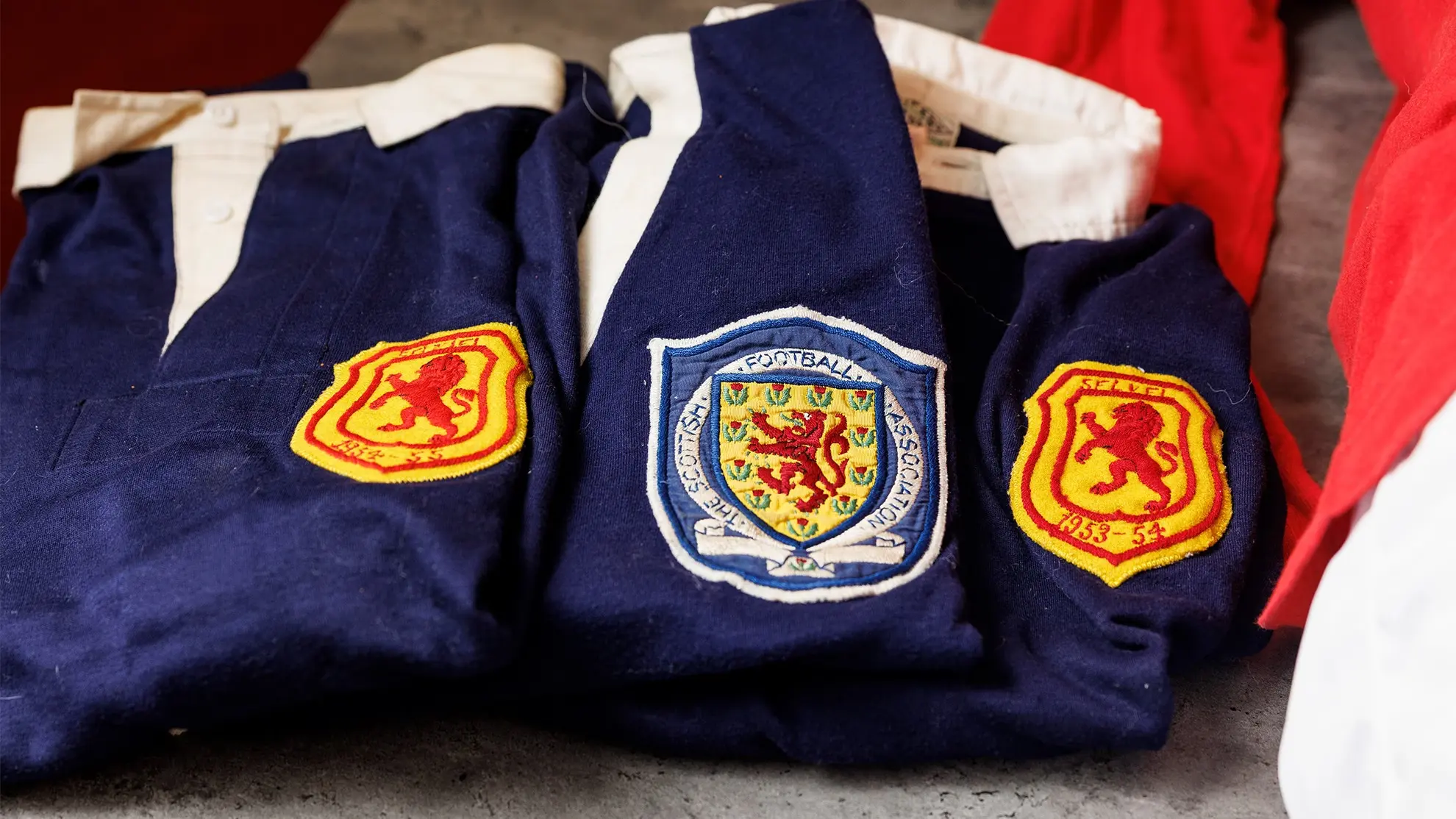
The Aberdeen FC Heritage Trust have recently added some very special items to their collection after Graham Leggat’s daughter, Alexandra, hand carried these wonderful artefacts back to Aberdeen from Canada…
The Aberdeen FC Heritage Trust have recently taken ownership of Graham Leggatt’s 1955 League Cup final shirt, as well as Scotland caps and medals belonging to one of Aberdeen’s greatest ever players – including his League Championship medal. The shirt is the oldest one in the Trust’s archive, and it was the one Graham wore when he scored the winning goal in the ‘55 final.
Graham Leggat was one of Scotland’s finest post-war wingers. The Aberdonian joined the Dons as a teenager and played a major part in the League Championship winning team of 1954/55 and the victorious League Cup side the following year. He also earned a Scottish Cup runners-up medal before being transferred to Fulham in 1958, where he became a star in England.
At international level Leggat was selected in the Scotland squad for the 1958 FIFA World Cup in Sweden, and earned 18 caps. With a phenomenal strike rate of more than 200 senior goals in 400 games – even more extraordinary when you consider he played most of his football on the right wing – Graham was a very special talent and a tremendous sportsman who registered 13 hat-tricks.
Graham emigrated to Canada where he became a famous TV commentator. He was inducted into the Canadian Soccer Hall of Fame in 2001. Graham died in his adopted country in August 2015 aged 81 and was posthumously inducted into the Aberdeen FC Hall of Fame in 2017.
Graham’s daughter Alexandra Leggat brought the memorabilia back to Aberdeen from Canada.
“It is the first time I have been back to Aberdeen since Dad was inaugurated into the AFC Hall of Fame in 2017. It feels great to be back because it really feels like home. I was born in England, my brother and I, so growing up we were in the UK.
“It is also emotional. When my Dad passed away, I said to him, because I have ashes in my living room, ‘Dad, one day I’m going to take part of you home.’ So we did sprinkle some of Dad’s ashes at his family cemetery, which is really lovely, because he was a big family man. He was such a family person.
“And then to be able to bring Dad’s memorabilia back to Pittodrie. So very emotional, it’s beautiful actually. It’s always difficult because there’s so much sentimental value with each of the items, but it’s going to a good home. I was getting older and I thought, ‘What’s going to happen to them?’ I didn’t want to put them up for auction as the items could just land up anywhere. This is his home, this is where he’s from.”
Growing up in Canada Alexandra herself became a football fan but did not fully appreciate just how good a player her dad was.
“It took a while, because he was so humble and modest. We would watch games together but would never say anything. Growing up, he was just my dad. And then, of course, as I got older, I started to realise. It was when he became a broadcaster that I started to learn more about him and I looked through the scrapbooks and read bios of him, and I was like, ‘Crikey, my Dad was kind of good!’ I have a lot of old black and white film of Dad playing.
“I know from the conversations we then had that he loved his time at Aberdeen. I think he maybe wished he could have stayed longer at the club. He never had anything bad to say about being here. I think going to England at first was probably a little bit hard for him but like so many players back then, that is what he had to do. And players nowadays are moving around all the time.
“He really enjoyed his TV work but missed playing. He would tell me about his dreams where, he’d be running for the bus and he’d miss the bus to a game. Or he’d open his locker and his football boots wouldn’t be there. He missed playing so I think the broadcasting was great for him. He was to be able to watch players, watch the teams. He was very unbiased and respected for that. He became the voice of soccer in Canada. That’s what they called him. Dad helped bring the game to Canada and make it what it is today.
“Dad really enjoyed living in Canada with his family. He was a family man, everything for him was family. But was missed his family here. Part of the reason why I brought his ashes home is he missed home, he missed family.
“I also know Dad’s stuff is safe with the Heritage Trust.”
EARLY LIFE
Born in Aberdeen on 20th June 1934, Graham Leggat was an outstanding talent from an early age. Even while playing local schools football, he looked destined to be a player of some note, although he was also a very good rugby player and would have almost certainly played for Scotland had he chosen that sport. He grew up in the Hilton area and was spotted as a ten year-old at Woodside Primary before playing for Aberdeen Schools, the youth side Torry FP before, aged 17, he joined Banks o’ Dee and Aberdeen moved quickly to sign him on a provisional form.
During the summer of 1953, Graham was called up by the Dons and his talent was such that he was pitched straight into the first team at outside right, where he made a tremendous impact in his first season. He made his debut in a 1-0 league defeat away to Stirling Albion in September 1953, but got revenge on Boxing Day when Aberdeen beat Stirling 8-0 and Graham grabbed a brace.
ABERDEEN
Leggat had all the attributes normally associated with a top class player: natural ability, mental and physical agility, speed and a knack of improvising to outwit an opponent. His introduction to the Dons side in 1953 was probably the biggest factor in turning Aberdeen from a side that habitually came close into one that rose to the top of Scottish football in 1955.
Graham played five seasons for the Dons from 1953/54 to 1957/58, picking up a league title in 1955 and a League Cup medal the following season. He also played in the 1954 Scottish Cup final when Aberdeen lost 2-1 to Celtic.
Following the title triumph of 1955, Graham’s goalscoring was a big factor in the Dons’ 1955/56 League Cup success, with Leggat scoring nine goals in 10 ties, including the winner in the final itself against St Mirren at Hampden.
That goal brought heated debate.
Some suggested his incredible shot from 35 yards was a ‘fluke’ and not meant. Those lucky enough to see Leggat play for the Dons would suggest otherwise, and lobbing keepers at Hampden was to become his speciality.
Graham’s stats are astonishing and highlight just why he is regarded as one of our greatest ever players. He scored 92 goals in only 152 appearances during his time at Pittodrie. He netted five hat-tricks for the club against Hearts (twice), Clyde, Motherwell and Airdrie.
Airdrie would have been glad to see the back of him as he netted five at Broomfield in his last season in a 6-2 league win. In fact, his best return was against the Lanarkshire side as 11 of his 92 goals were scored against them.
Such was his impact that, to the tune of “Davy Crockett – King of the Wild Frontier”, Leggat was serenaded by his adoring supporters as the “King of Pittodrie Park”.
‘Serenaded’ might be a rather kind verdict on the crowd’s singing ability, but you get the picture.
SCOTLAND
With several Scottish Under-23 caps behind him, Graham was promoted to the full international side for the England game at Hampden on April 14th 1956. The Scots were seen as lambs to the slaughter by the English press but a remarkable lobbed goal by the debutant Leggat put Scotland ahead in the second half and only a last gasp equaliser prevented the home side registering their first Hampden win over the Auld Enemy in almost 20 years.
A second cap against Wales in Cardiff in October 1956 seemed to herald a long international future for Graham but injury kept his name out of the frame for a while, and it wasn’t until October 5th 1957 that the winger got another call to do battle, against Northern Ireland in Belfast. Again Leggat did the honours with the Scots’ only goal in a 1-1 draw, but disaster was only weeks away as Graham broke a leg in late October and was sidelined for much of the season.
A trained PE teacher, Leggat confounded the critics who wrote him off following his leg break and made a full recovery. With Scotland heading to Sweden for the 1958 World Cup, the selectors picked him for a warm up friendly against Hungary at Hampden in May 1958 and Graham took the opportunity to seal his place in the Scottish squad to travel to Sweden.
A final warm up friendly in Poland was the curtain raiser to the main event, the World Cup itself, and the Scots, with Leggat prominent, did well to hold highly fancied Yugoslavia to a 1-1 draw. The next game was a real tester against Paraguay, and Scotland suffered a 2-3 loss to the South Americans, Leggat left out of the side for the final game against France.
ENGLAND
International recognition is so often a double edged sword for the parent club, and it proved the case as far as Leggat was concerned. Clubs in England were alerted to his talent and in August 1958, he moved on to Fulham for what still seems a paltry sum of £16,000, even by the standards of those days.
That he should move on was perhaps no shock but the fact he signed for Fulham, then in the Second Division, was a little more surprising, for he looked every inch the elite level player. He took little time in rectifying that, helping Fulham to win promotion in his first season and then, once they were in the top flight, top scoring for the club in five of the next seven seasons.
Fulham were an attractive side to watch, especially at their Craven Cottage home on the banks of the Thames.
Leggat formed a particularly impressive partnership with Johnny Haynes, the England captain at the time, and the man who would become the first £100 a week footballer once the maximum wage was abolished in 1961. Suffice to say, the other players did not enjoy quite the same level of pay.
Haynes was not the only top line player to share a dressing room with Leggat across his eight years with the London club. Jimmy Hill was there in Leggat’s early days, Bobby Robson rejoined his former club after the 1962 World Cup, England World Cup winner George Cohen was making his way as a top class right-back, Alan Mullery began his career there, as did Rodney Marsh, who snatched the top scorer award from Leggat for one season.
For all that talent, Fulham were never a side that could find the consistency to really get a challenge together in the First Division. Tenth in their first season back was the best they managed during Graham’s time, the rest of their seasons spent in the bottom half of the table, occasionally flirting with the drop.
FA Cup glory almost came their way in 1961/62, battling their way to the semi-final where they were drawn against Burnley, then a real powerhouse who had won the First Division in 1959/60. Leggat gave his side a first half lead in the meeting at Villa Park but Burnley forced a replay and won the replay 2-1 at Leicester’s Filbert Street – Burnley were runners up in league and FA Cup that season.
As at Aberdeen, Leggat’s statistics at Fulham are verging on the ridiculous. He scored 134 goals in 280 games for the Cottagers, including eight hat-tricks. One of those wrote his name into the record books when he netted the fastest treble in top flight history in just three minutes as Fulham famously defeated Ipswich Town 10-1 on Boxing Day in 1963. It was a record that stood until the 2014/15 season, when it was beaten by Sadio Mané for Southampton against Aston Villa.
The emergence of Allan Clarke, later famed as the goal poacher supreme for Don Revie’s Leeds United, saw Leggat usurped as top goalscorer and in January 1967, he moved to Birmingham City, the Fulham fans in the same kind of uproar about the decision as the Red Army had been in 1958. To be fair, Fulham had judged his departure about right, for from there, Graham never touched the heights again and his career wound down with brief spells with Birmingham, Rotherham United and then non-league Bromsgrove Rovers, as well as a spell coaching at Aston Villa. He hung up his boots on some remarkable numbers – more than 200 senior goals in 400 games, with 13 hat-tricks to be taken into further consideration.
CANANDA
In 1971, he moved to Canada in order to manage the Toronto Metros, and he later worked as a journalist and commentator. He did soccer telecasts for the CBC at the 1976 Summer Olympics and at the World Cup and then became host of Ontario-based sports network TSN’s popular Soccer Saturday programme as well as an on-air analyst on its live games.
THE SHIRT
The shirts for the 1955 League Cup final were procured from Peter Craigmyle’s sports shop on King Street.
It was also the very first shirt Aberdeen players were allowed to keep. Before that, they were handed down to the reserves or used at training.
Peter Craigmyle, originally from Oldmeldrum, was a well-known figure in the North-east, earning great respect through over 30 years of refereeing. He was brought up in Aberdeen and it was by a twist of fate that he became a football official. In August 1916, he broke both legs in an accident in a naval dockyard in Invergordon. Back then young Craigmyle played in goal for Linksfield as well as water polo and cricket. His accident during the Great War put paid to that.
A chance meeting with Aberdeen manager Jimmy Philip in 1918 persuaded him to take up a career as a referee. Philip had been a referee in his day before he took on the role as the first Aberdeen manager in 1903.
By 1919, after progressing through the initial ranks, Philip asked Craigmyle to take charge of friendly matches as Aberdeen welcomed Albion Rovers, Third Lanark, Partick and Hearts. It all came together for Craigmyle as reports of how well he had officiated circulated. The fact that Aberdeen had yet to produce a first class referee was in his favour. Later that year he was accepted as a referee by the SFA and Scottish League. Peter asked Aberdeen for use of their training facilities and not only did Philip agree, he insisted on Craigmyle training with the team which included the likes of Alec Jackson, Jock Hutton and Matt Forsyth.
After ‘serving his time’ in the rough fields and crowds of the Highland League, Craigmyle took charge of a top flight game for the first time in 1920 at Tynecastle in a Hearts v Albion Rovers meeting. Two years later, he was due to take charge of a game in the south when a rail strike wrecked his travel plans. The call came from Pittodrie as a referee was required for the Dons match against Morton. Refereeing an Aberdeen game in front of 25,000 supporters was a tough task, but Craigmyle showed enough quality to suggest he was destined for a lengthy career as a referee.
In December 1921 Peter sent off his first player, Celtic’s Joe Cassidy, after he threw a punch at Falkirk defender Tommy Scott, a blow that effectively knocked him out and split his jaw. In his 31 years as a referee, Craigmyle only ever sent off two players.
In 1924 Craigmyle took charge of his first full international, at Liverpool where England played Ireland. Craigmyle is known to have officiated 26 international matches from 1924 to 1946. He refereed three Scotland-England international matches, at Hampden Park in 1941, 1943 and 1946. In 1931 he took charge of the Scottish Cup final between Celtic and Motherwell.
In 1933, Peter Craigmyle was the first referee ever to fly to a game, from Inverness to the Orkney Isles where he took charge of an inter-island game against Shetland. Peter had been taking charge of these games since 1928, but always made his way there by ferry. Craigmyle also came across a rare talent when he was refereeing a Dundee Utd v Montrose Scottish Cup tie.
A young Benny Yorston was in the stripes of Montrose and he was to the fore as Montrose earned a 1-1 draw with Yorston scoring. It was on the back of that performance that Yorston was signed by Aberdeen in 1927.
When Craigmyle finally hung up his whistle in 1949, he then owned a sports shop and wholesale tobacconists on King Street, Aberdeen. He was also a keen bowls player and president of a number of bowling clubs in Aberdeen.
He was a trained vocalist and an accomplished stage performer, master of ceremonies, lecturer, event compere and organizer. During World War II, he organised and produced shows at many venues in North East Scotland, including Aberdeen’s Garrison Theatre and ran classical music concerts in the Cowdray Hall, Aberdeen, to raise money for the troops. Craigmyle also had a radio sports programme on the local 2DB station in Aberdeen in the late 1920s. He died on 21 November 1979 in Aberdeen.
His book A Lifetime of Soccer was published in 1949 by Aberdeen Journals and was republished in 2021 by his great-nephew. A website www.petercraigmyle.com and a new publication The Remarkable Story of Peter Craigmyle – The Fearless Aberdonian, launched in 2023 provides further insight, quoting over 700 press articles and features from 1919 to 2011.