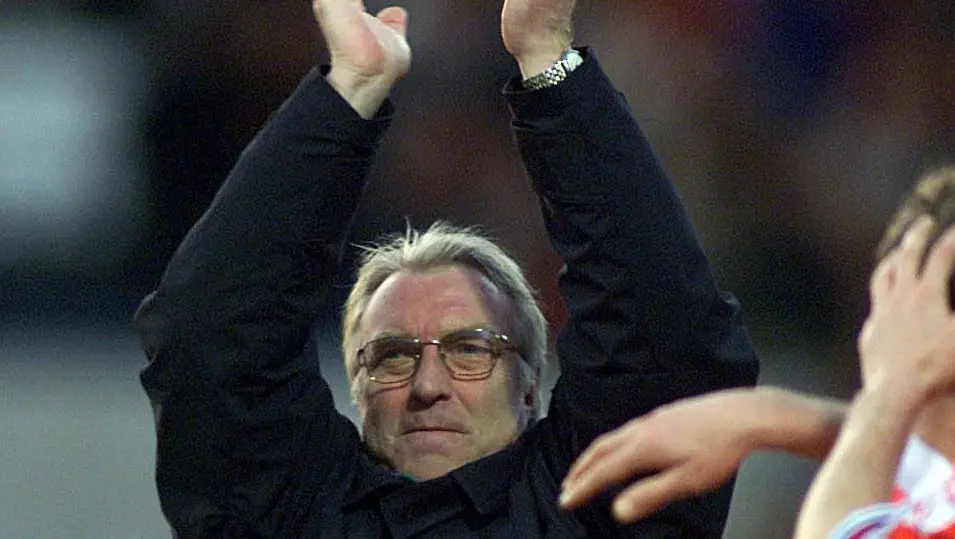
Tonight, Pittodrie will witness something it hasn’t seen for quite some considerable time; perhaps even going back to those optimistic, future-looking days of the tail end of the last century, when the doldrums of Hegarty, Miller and Aitken had been exited and the promise of an exotic Reds revolution lay ahead. Yes, this evening, someone will willingly turn up in Aberdeen’s stadium wearing a jersey with the name “EBBE” emblazoned on the back. Of course, ICT’s recently recruited Irish forward is not necessarily a fan of the Scandinavian coach once of this postcode. His manager might not be either, given that the Dane pulled the plug on a virtually done deal to sign the then-20-year-old hothead back in 2001. But should he be called upon to peel off his tracksuit and step up to the touchline proudly displaying the name to the world, it is to be sincerely hoped that the night’s events have unfolded sufficiently pleasantly to put the Red Army in high enough humour to greet Dean with a rousing chorus of “Ebbe, Ebbe, gies a wave”, which once we would sing to Mr Skovdahl in the days when we didn’t know any better. Though Skovdahl was regularly serenaded at grounds right around the country, you always felt there was a tinge of irony, or even black comedy, to it, as if Aberdeen fans were celebrating his crazy hair, wonky spectacles and Steve McClaren-ish grasp of English as the comic relief which made the desolation of the games themselves remotely bearable. Certainly, in the cold light of day, the chuntering about his formations, tactics, transfers and occasional absolute hammerings were more than just a discordant backing track to the terrace songs in his honour. But today, with the 15th anniversary of his resignation approaching in November, we should reassess Skovdahl’s legacy from the distance of a generation, and wonder whether perhaps the history books of our club will treat his work more kindly than we who lived through it instinctively might. For, in spite of his clownish, whimsical persona – partly self-perpetuated, good-natured radge that he is – Skovdahl was actually better at his job than most of those who came immediately before or after. The Pittodrie which Skovdahl entered in 1999 was one where standards and aspirations had been driven into the ground, and ultimately the Dane left the club in a noticeably healthier state than he had found it. While it is true that, after a debut campaign in which the listing ship well and truly bottomed out – quite simply the most bonkers season AFC will ever experience, replete with 83 league goals conceded, a last-place finish, and two cup finals (one played with a centre forward in goal) – giving Skovdahl credit for improving upon it is like praising terrorists for negotiating the end of a war they started, it remains the case that, in his three full seasons at the helm, Aberdeen finished tenth, then seventh, then fourth. While other Aberdeen managers around the turn of the century started unimpressively and got worse, Ebbe at least got a lot better. And though one of Ebbe’s first acts in Aberdeen was to spend approximately a million quid on some fairly ordinary players, he wasn’t long in figuring out that this was rather like inheriting a ruined castle and buying four rolls of luxury wallpaper. He promptly installed a slew of the club’s own promising youths – most notably Kevin McNaughton, Phil McGuire and the flourishing Russell Anderson, previously an under-appreciated rotational defender – and in so doing sowed the seeds for the relative success which, after a brief interlude, Jimmy Calderwood would eventually reap. To paraphrase Skovdahl himself, his operation went well overall, though the patient did not show any immediate signs of recovery. That it is now in such rude health under the care of Dr McInnes is partly thanks to those who initially prescribed a cure when it lay in its most critical state. Time for us to give you a wave back, Ebbe.
Tonight, Pittodrie will witness something it hasn’t seen for quite some considerable time; perhaps even going back to those optimistic, future-looking days of the tail end of the last century, when the doldrums of Hegarty, Miller and Aitken had been exited and the promise of an exotic Reds revolution lay ahead. Yes, this evening, someone will willingly turn up in Aberdeen’s stadium wearing a jersey with the name “EBBE” emblazoned on the back. Of course, ICT’s recently recruited Irish forward is not necessarily a fan of the Scandinavian coach once of this postcode. His manager might not be either, given that the Dane pulled the plug on a virtually done deal to sign the then-20-year-old hothead back in 2001. But should he be called upon to peel off his tracksuit and step up to the touchline proudly displaying the name to the world, it is to be sincerely hoped that the night’s events have unfolded sufficiently pleasantly to put the Red Army in high enough humour to greet Dean with a rousing chorus of “Ebbe, Ebbe, gies a wave”, which once we would sing to Mr Skovdahl in the days when we didn’t know any better. Though Skovdahl was regularly serenaded at grounds right around the country, you always felt there was a tinge of irony, or even black comedy, to it, as if Aberdeen fans were celebrating his crazy hair, wonky spectacles and Steve McClaren-ish grasp of English as the comic relief which made the desolation of the games themselves remotely bearable. Certainly, in the cold light of day, the chuntering about his formations, tactics, transfers and occasional absolute hammerings were more than just a discordant backing track to the terrace songs in his honour. But today, with the 15th anniversary of his resignation approaching in November, we should reassess Skovdahl’s legacy from the distance of a generation, and wonder whether perhaps the history books of our club will treat his work more kindly than we who lived through it instinctively might. For, in spite of his clownish, whimsical persona – partly self-perpetuated, good-natured radge that he is – Skovdahl was actually better at his job than most of those who came immediately before or after. The Pittodrie which Skovdahl entered in 1999 was one where standards and aspirations had been driven into the ground, and ultimately the Dane left the club in a noticeably healthier state than he had found it. While it is true that, after a debut campaign in which the listing ship well and truly bottomed out – quite simply the most bonkers season AFC will ever experience, replete with 83 league goals conceded, a last-place finish, and two cup finals (one played with a centre forward in goal) – giving Skovdahl credit for improving upon it is like praising terrorists for negotiating the end of a war they started, it remains the case that, in his three full seasons at the helm, Aberdeen finished tenth, then seventh, then fourth. While other Aberdeen managers around the turn of the century started unimpressively and got worse, Ebbe at least got a lot better. And though one of Ebbe’s first acts in Aberdeen was to spend approximately a million quid on some fairly ordinary players, he wasn’t long in figuring out that this was rather like inheriting a ruined castle and buying four rolls of luxury wallpaper. He promptly installed a slew of the club’s own promising youths – most notably Kevin McNaughton, Phil McGuire and the flourishing Russell Anderson, previously an under-appreciated rotational defender – and in so doing sowed the seeds for the relative success which, after a brief interlude, Jimmy Calderwood would eventually reap. To paraphrase Skovdahl himself, his operation went well overall, though the patient did not show any immediate signs of recovery. That it is now in such rude health under the care of Dr McInnes is partly thanks to those who initially prescribed a cure when it lay in its most critical state. Time for us to give you a wave back, Ebbe.