The 11th May will always be a special date in Aberdeen FC history.
As well as winning the European Cup Winners Cup in 1983 it was on that date in 1946 when Aberdeen prevailed in what was their first success on the national stage in 43 years of existence.
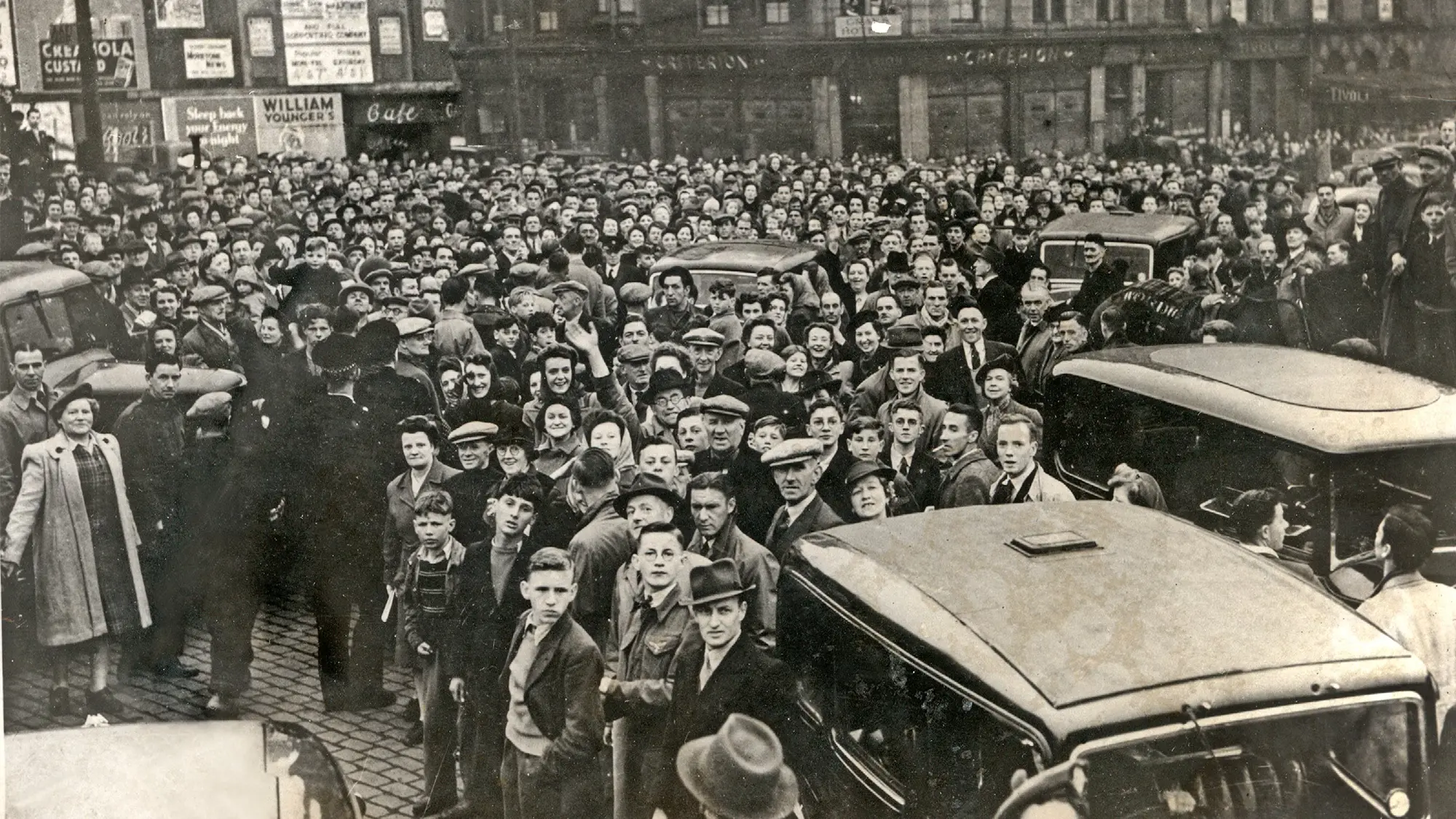
Following the Dons’ stunning success against Rangers in the Southern League Cup Final, thousands gathered in and around Aberdeen Joint Station to welcome their heroes home. The citizens of Aberdeen had not seen anything quite like it when it came to sport.
This weekend, with the passing of Alex Kiddie, who played a vital role in that cup final win, the club sadly lost a friend and the final surviving player of our first ever trophy winning side.
The Red Matchday team look back at what was happening at Pittodrie back then …
Civil life was still only just getting back to some kind of normality and calm following the end of hostilities in Europe, if that was possible in such a short space of time after the horrors of World War Two. But now the people of Aberdeen had something to cheer locally.
The war time competition was of course the forerunner of the League Cup we know today, and the 1946 competition was the last of a series of cup competitions that were held to keep football going through the war years.
While the Second World War had effectively brought the country to a standstill, the authorities were determined to raise morale. Football had to continue to keep spirits high and in the north east, Aberdeen were enjoying competing in the various regional league and cup competitions. During the war years Aberdeen dominated the regional competitions and that success brought renewed optimism on the national stage.
Before the outbreak of hostilities in September 1939 the cold reality was that in their 36 years of existence Aberdeen had won nothing.
It was still a real blight on Aberdeen FC history that they had not secured a major title before the outbreak of the war. Certainly the Dons had come close with a credible league challenge in 1911 and just losing out in the 1937 Cup Final. For all the talent of players such as Willie Lennie, Charlie O’Hagan, Donald Colman, Benny Yorston, Willie Mills, Matt Armstrong, Willie Cooper, and their like, success had eluded the extremely gifted Black & Gold Aberdeen side of the 30’s. Certainly Aberdeen came agonisingly close to taking the Scottish Cup in ’37, but the reality was that they had nothing to show in terms of honours.
Aberdeen followers had been brought up in the proper traditions of the passing game and appreciation for the finer arts was of little compensation for tangible success. The general feeling was that it was readily accepted that Aberdeen would rid themselves of their runners up badges in time.
The first signs that the club would break the mould came during those dark days of World War Two.
In the relative obscurity of the hastily arranged wartime leagues it was Aberdeen who emerged as by far the most successful side. It could be argued that the quality of opposition was not as strong as it might have been.
Those North Eastern Leagues were made up of sides from the east coast and a makeshift Rangers side. There was perhaps some truth in that claim, but it proved that Aberdeen could indeed win on the national stage and the success gained was met with widespread approval in the North East. Aberdeen won four of the eight league sections that were contested during the war years. The Mitchell Cup, another trophy that was put up for competition during that time, was also secured. Aberdeen had acquired a taste for silverware and following the end of the war in 1945, it added to the feel good factor that was present.
Aberdeen had convinced themselves that they could win but any kind of credibility could only be gauged against what was achieved against Celtic and Rangers.
In season 1945-46 it was deemed an unofficial league and cup competition as the authorities took the opportunity to revamp the structure of the game in Scotland. The wholesale changes meant that there were casualties, with several of the games lesser lights missing out on a place in the top division. It was an opportune moment for the Scottish League to act and many clubs would take years to recover. Aberdeen had escaped the cull mainly due to the sterling work carried through by the Dons directors and administrators during the war time period.
So the game returned to some semblance of normality it was the Dons now sporting red and white that would shine. The challenge for the oddly named Southern League was admirable; the Dons finished in third place behind Rangers and Hibernian. However, success was to be achieved in the Southern League Cup a new competition introduced in the continuing absence of the Scottish Cup. Aberdeen had done well in the regional competitions and they carried that form on to the national stage by winning the trophy in its’ only year of competition. Any side that had such lofty ambitions would have to take care of the Old Firm in their own backyard and it was against Rangers in the Southern Cup Final in May 1946 that Aberdeen won their first major trophy.
A huge 130,000 crowd filled the national stadium and they did not have to wait long for the opener as Aberdeen hit Rangers in the first minute with a well worked goal. A long throw from Andy Cowie was flicked on by Stan Williams and Archie Baird timed his run to perfection to ghost in past the Rangers defence to give the Dons an early lead. The first half was played at frantic pace and Aberdeen kept up the pressure on a stunned Rangers side who had rarely been tested that season. Williams and then McCall had chances to put Aberdeen further ahead as the Ibrox club were struggling to cope with the pace of the Aberdeen forwards. After 18 minutes, Aberdeen went two goals ahead with a classic move.
Alex Kiddie won the ball from Rangers’ Shaw on the right and he raced clear. Kiddie crossed for George Hamilton, who set up Stan Williams to put Aberdeen well in control.
Rangers were a more determined side in the second half and after Duncanson had pulled one back minutes after the restart, the pressure was now on Aberdeen. Kiddie was tormenting Shaw on the right and he came close when his drive rattled the bar and Aberdeen struck woodwork again when Cowie’s shot was deflected on to the post. But with 20 minutes to go, Rangers levelled the tie against the run of play when Thornton beat Johnstone from inside the box. A pulsating final culminated in Kiddie crossing for Taylor to score the winning goal in the final minute to take the cup north to Aberdeen.
The team was to return as conquering heroes; an unlikely reaction given the makeshift nature of the new competition. Perhaps it was a welcome end to the trophy drought, but the almost hysterical reaction was neither predicted nor expected.
When Aberdeen did finally return home, it was announced that those supporters who did not see the team on their return would get a glimpse of the trophy when it was transferred to “The Weekly Journal” offices at 319 Union Street in the city centre. The cup was placed in the front shop window by the Marchioness of Huntly, a director of Aberdeen Journals to whose temporary custody of the cup was given by Aberdeen chairman William Mitchell. Present at the ceremony were Aberdeen manager Dave Halliday, William Philip, the club director, and William Veitch, the managing director of Aberdeen Journals.
The cup was on display in all its glory but was only there for a few days. The Scottish League had requested its return as the hastily arranged Scottish Victory Cup competition was held in May 1946, but there was no trophy to present to the winners. It was a tough call on Aberdeen whose first national success was indeed short lived.
Nevertheless it proved that Aberdeen were indeed now a major force in the Scottish game and they were to improve on that less than a year later by winning the Scottish Cup.